
A Monetary History of Albert Einstein's Special Theory of Relativity
( Or—how to out-chit-chat-ChatGPT! )
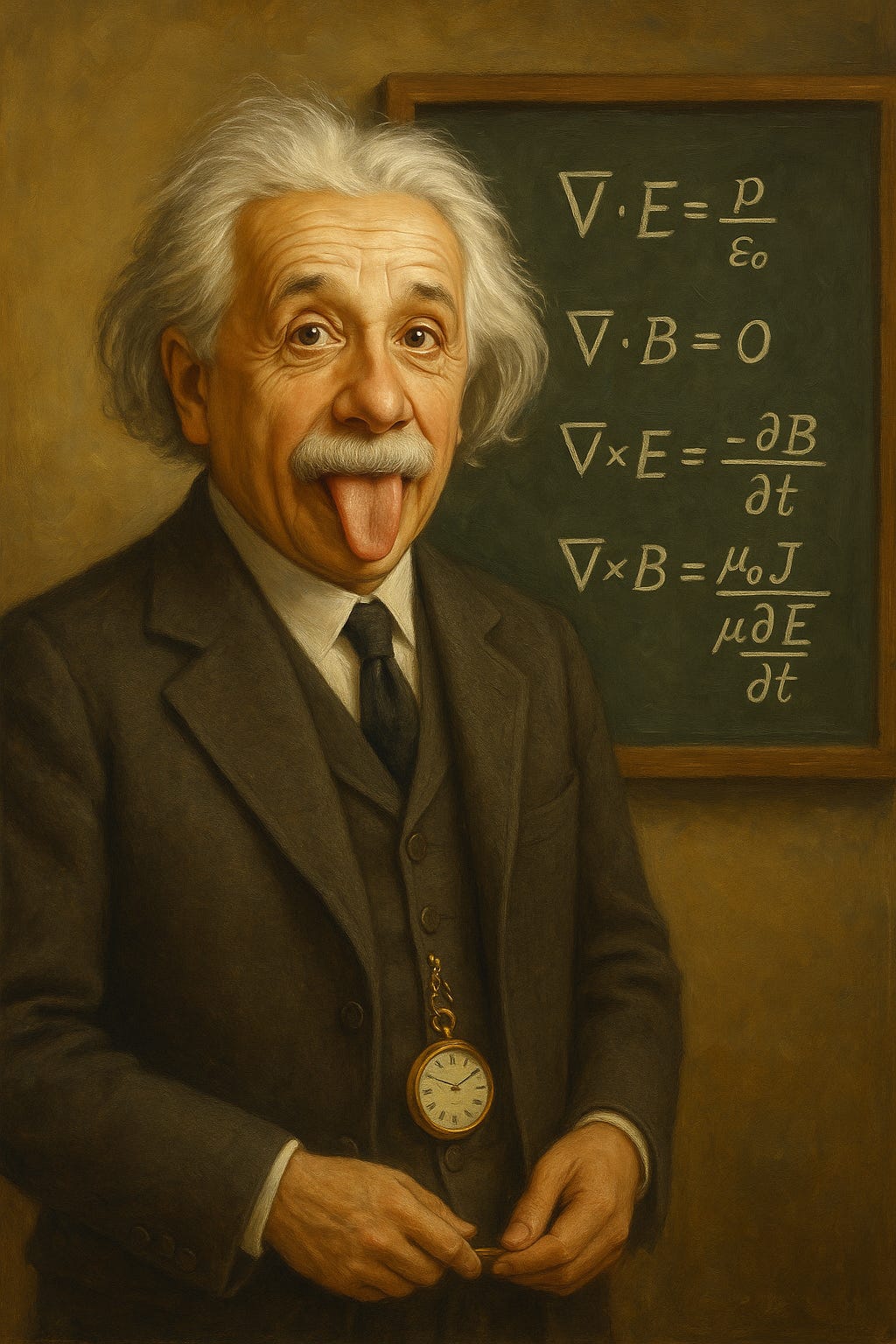
“So, you had to take these equations and realize—the impact—that taking them seriously had on one’s notions of space and time.”
—Sir Roger Penrose, discussing Albert Einstein’s interpretation of James Clerk Maxwell’s equations that integrated electricity and magnetism. 1
“The greatest shortcoming of the human race is our inability to understand the exponential function.”
—Albert Bartlett. 2
“If you’re going to have any hope of reaching the human operating system you gotta have a story. And if you’re going to make up a story, make up #*µ@#∞!^# story!”
— Jim O’Shaughnessy 3
Prologue
Do a Google or Bing search. Something to the effect of, “Did Albert Einstein really say, ‘Compound interest is the greatest mathematical discovery of all time?’” I haven’t done it recently, but I’ve done it a lot. You can imagine variations on that query, of course. But while you’ll get a lot of stuff back — some of which could be useful if you sort of sort through it and make it actionable — you’re not going to find a deeply satisfying answer to that question. Not if you dig. You may be wondering why there would be a deeply satisfying answer to that question?
It really is too shocking…
ChatGPT can be fun, too. My first query was spontaneous—
“Best argument that Einstein said, ‘compounding is the greatest mathematical discovery of all time.’”
Response: “It is not clear that Einstein ever said or wrote that compounding is …” etc., etc.
Here’s a less spontaneous query—
“I want you to make up a story for why Albert Einstein might have said, ‘Compound interest is the greatest mathematical discovery of all time,’ when to believe that defies common sense.”
Seems like a better question! There’s lots of science and information and stuff that can be scraped and—might as well throw in a wrench—it also seems like there’s a kind of common-sensical notion that “CIGMDOAT,” doesn’t sound like something the guy would say? He was a math whiz! So … make up a story, ChatGPT. Chat away. Make something up. Use the best information available about Albert Einstein, his life, his contributions to science, his humanity, (his sense of humor), what we now know about how the universe works, and make something up—a story—for why Albert Einstein might have said “CIGMDOAT,” when to believe that defies common sense.
I got a very different kind of response to that second query. It’s in the notes,4 look at them later, on your own time, though, because here’s the important part: As good as I think ChatGPT’s answer was … I can’t find—for the life of me—anything it, like, made up. Okay! Fine! ChatGPT scraped and assembled information and made up a story. A good one. I’m impressed. Really, I am. But … still? … There’s a sense that it made up a story using things we already know. Right? It made up a story using things we already know. It didn’t make up a story using things we, you know … don’t know. The kinda stuff you just make up! 5
We’re going to make something up. Something simple. And use that simple something to blow the lid off why “CIGMDOAT” is exactly what Albert Einstein would say!
Story
Here’s a quote you don’t hear every day—“Compound interest is the greatest mathematical discovery of all time.”
I don’t hear it at all. Not sure I ever did. That quote is attributed to Albert Einstein, of course. 6 You hear other, “Albert Einstein reportedly said such and such about compounding …” quotes. But you don’t hear, “Albert Einstein said ‘CIGMDOAT’” quotes. I don’t. Maybe you don’t either. Maybe even without knowing all the moving parts you have — like me — a vague intuition of why this might be:
In 1905 Albert Einstein — then a 26-year-old technical assistant at the patent office in Bern, Switzerland — submitted four papers to a German scientific journal. The first paper on the photoelectric effect won the Nobel Prize and helped launch a quantum revolution. The second paper provided the first proof of the existence of atoms. The fourth brought into being the famous equation E=MC² relating mass and energy. But the third paper may have been the most significant of all. It gave us the Special Theory of Relativity. A decade later he published the General Theory of Relativity.7
I don’t know! “CIGMDOAT”? Doesn’t sound like something the guy would say. And this will not surprise you either — all that stuff up there? Math! Hard math. Civilizational math, even. “Compound interest is the greatest mathematical discovery of all time”? … Really?
A literal interpretation of that quote is…
“FV = PV(1+i) n … is the greatest mathematical discovery of all time.”
Really? Yes, I know, I’m repeating myself, but … really?
Forget about all those quanta and atoms, energy and mass, all that curvature and warping of space-time—that whole gravity thing. Rulers getting shorter and longer, clocks ticking slower and faster, all that other math, (E = MC 2), and what not. Nope!
“FV = PV(1+i) n is the greatest mathematical discovery of all time”
………… Really?
Let’s make something up. Something simple. Call it … spooky-entanglement. (Not spooky-entanglement-at-a-distance, that may already be made up). The something we’re making up is the spooky-entanglement between compound interest and Albert Einstein’s conceptual model of space-time. Except it’s not spooky. (Just made that up!) The entanglement part isn’t made up, though. That’s real.
To get our arms around this we’re going to lean on our pal Joel Greenblatt. More specifically, some intel from his wonderful must read book, “Common Sense.”8 Don’t worry. This isn’t a lecture on why you should start investing sooner rather than later (Though you should definitely do that!). Rather, we’re going to carjack Greenblatt’s model to measure an Investors’ (Observers’) speed through a fourth-dimension of Albert Einstein’s conceptual model of spacetime. Here’s the Setup:
(Note—I’ve fiendishly planted the “Observer” notations.)
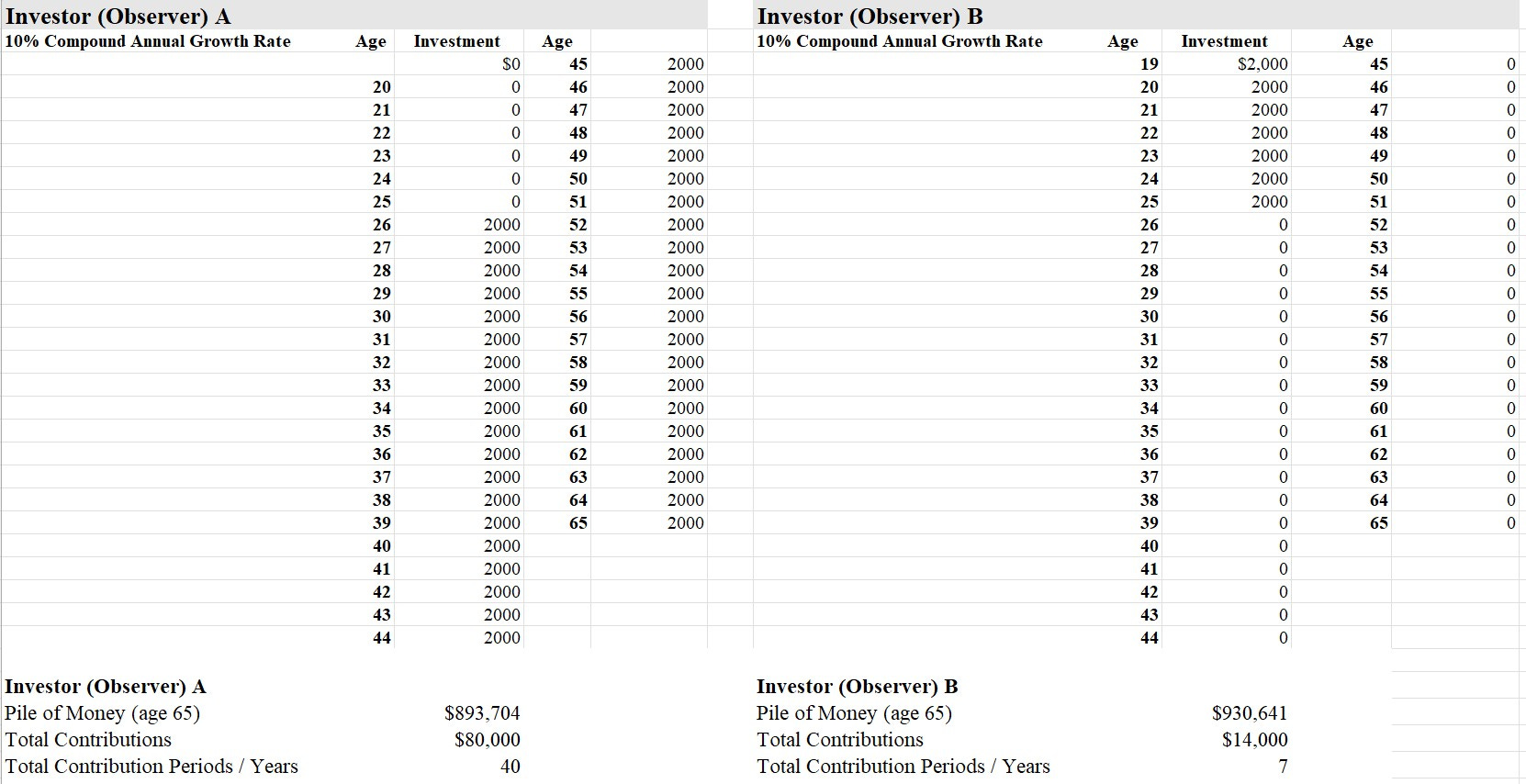
Investor (Observer) A invests $2,000 a year from age 26 to 65—40 contributions—earning 10% annually.
Investor (Observer) B starts earlier, investing $2,000 a year from age 19 to 25—just 7 contributions—then stops entirely, also earning 10% annually.
Here’s the business end:
Let’s structure that in our cognitive-wetware like this:
Investor (Observer) A has 1) a total dollar cost of $80,000, and 2) a total time cost of 40- years—because they wait 7-years to start investing.
Investor (Observer) B has 1) a total dollar cost of $14,000, and 2) a total time cost of 7-years—because they do not wait 7-years to start investing.
If you gave a sufficiently motivated high school student a homework assignment with instructions to take those two bullet points and conjure up a top-two list of the most insightful questions they can think of, which two questions would they choose? As it turns out — shockingly! — the universe bends itself around the answer to the second of those questions.
Here's the first one:
During the 7-years that an Investor (Observer) waits to start investing, how fast is their cost—in dollars—increasing—or, accelerating away from them, let’s say? After all, if they start now, it costs them $7,000. If they start in seven years it costs them $40,000. That cost over the 7-years they wait is increasing at some rate.
Well, we can get a pretty good back of the envelope on this by algebraically manipulating the “GMDOAT”—
FV = PV(1+i) n
to …

Now all we have to do is:
Replace (n) with the 7-years that they wait.
Set FV to $80,000 (the Future Value of the cost if they wait 7-years).
Set PV to $14,000 (the Present Value of the cost if they do not wait 7-years).
Plug those in…

This is all back of the envelope, remember. But in general, you could imagine the answer to our question of how fast an Investors’ (Observers’) cost increases—or accelerates away from them—during the 7-years they wait—is 28.3%.9
There’s more than one way to look at this, of course, but you might imagine your financial advisor—“See that?... it’s like your financial goals accelerating away from you at a 28.3% rate.” (They would have a point!)
Now—what’s the second question? Here’s a hint; Albert Einstein thought a lot about IT. Albert Einstein thought a lot about time.
During the 7-years that an Investor (Observer) waits to start investing, how fast is their cost—in time—increasing—or accelerating away from them? After all, if they start now, it costs them seven years. If they start in seven years it costs them 40 years. That cost over the 7-years they wait is increasing from 7 years to 40 years at some rate.
n is still the 7-years they wait.
Set FV to 40-years, the Future Value of the cost—in time—if an Investor (Observer) waits 7-years.
Set PV to 7-years, the Present Value of the cost—in time—if an Investor (Observer) does not wait 7-years.
Plug those in…
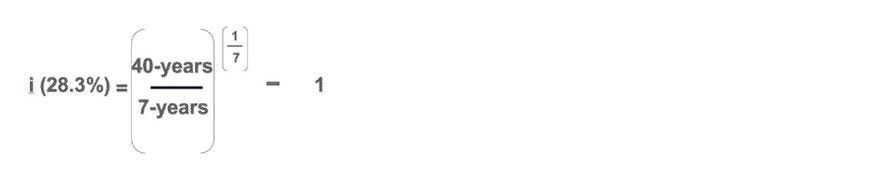
That’s interesting. I mean when you think about it.10 And not just because of Benjamin Franklin’s well-worn quip about the symmetry of time and money. But is there anything else you notice about it?... You know what I think Albert Einstein noticed about it? He noticed that time was …… moving?
Wait, let’s think about this a second … “i” is measuring the rate of change of something. But what exactly is the something that “i” is measuring the rate of change of? Well, it seems to be measuring the rate of change of … time. 11
There’s more than one way to look at this, of course, but you might imagine Albert Einstein now your financial advisor—“See that?... it’s like time accelerating away from you at a 28.3% rate.” (He would have a point!)
But—just to be specific: That time is accelerating away from you at what happens, in this case, to be a 28.3% rate—as nightmarish as that sounds—and is!— specifically?... is not the point. Not specifically. Specifically—the point is—time is relative.
“So, you had to take these equations and realize—the impact—that taking them seriously had on one’s notions of space and time.”
Remember that quote? We started with that quote. Roger Penrose.12 But again, Penrose is discussing Albert Einstein’s interpretation of James Clerk Maxwell’s equations that integrated electricity and magnetism. Not compounding. So … what gives?
This:
Einstein took Maxwell’s equations seriously (literally, if I may 13 ).
Einstein took Maxwell’s equations literally. And in so doing had to change his notions of space and time.
Great! So? … What did Maxwell’s equations say that Einstein took literally, then?
Maxwell’s equations said that the speed of light was 186,000 miles per second. That’s it! Well, there’s other stuff too, but the main thing is Maxwell’s equations showed the speed of light to be 186,000 miles per second.
Something that Maxwell’s equations had less to say about … though … was whether the speed of light was additive or subtractive. Which is to say, based just on Maxwell’s equations you might expect that if you were moving toward a light source at, say, 1,000 miles per second, then that light beam would hit you at 187,000 miles per second. The speed would be additive. Or, if you were moving away from a light source at 1,000 miles per second, that light beam would hit you at 185,000 miles per second. The speed would be subtractive.
No! Einstein took Maxwell’s equations literally. The math says the speed of light is 186,000 miles per second. Period. End of story. Regardless of your direction or how fast you are moving, a beam of light will always hit you at 186,000 miles per second.
Well ……… how in the world universe do you make that work?
If you’re Albert Einstein you make that work by holding the speed of light constant, but adjusting the clock rate (time), of the observer.14 If an observer is traveling at great speed — near the speed of light — that observer’s clock rate (time) slows relative to an observer not traveling at that great speed.
It seems a bit of a mathematical card trick but what is stupendous! is that time and space actually behave like this. If you blasted off for a distant planet at nearly the speed of light, turned around and came home again, you would find when you returned that you had aged much less than the folks you came home to.
Why might Einstein have thought he could do / get away with this? This adjusting of an Observers clock rate—their time?
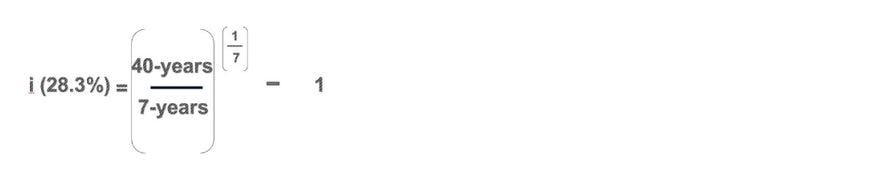
Isn’t that what we’re doing here? Adjusting this Observers clock rate? Their time? 15
I’m just sayin! It does seem very - I dunno - clueish? I mean …… what is the literal interpretation of this equation?
During the seven years that an Investor (Observer) waits, time is accelerating away from them at a rate of 28.3%—ergo—time is relative.
True, it’s in the fourth-dimension so they don’t notice it. But Albert Einstein—a guy that took math seriously—did.
It would have suggested to him that the clock rate (time) of the observer could be made …… malleable …… let’s say. Flexible. It could be adjusted. That it was mathematically feasible to shuffle that deck. And for Albert Einstein who, from the age of sixteen, when he said he began working on Relativity, and—apparently—very keen on finding a way to hold the speed of light constant—well, shuffling that deck must have looked pretty good!
Hold the speed of light constant. Adjust the clock rate (time) of the observer. And whaddya know! The universe bends around that.
Shocking isn’t it! 16
That’s Albert Einstein’s Special Theory of Relativity. A decade later he published the General Theory of Relativity that incorporated gravity.
We tend to think about compound interest occasionally, it seems to have something to do with money we know, and that’s true enough. But it doesn’t seem like compound interest would be the greatest mathematical discovery of all time…
Compound interest is not the GMDOAT because it’s a powerful tool to conservatively save and invest a significant portion of your income at a reasonable rate of return (starting early) and letting it compound over a long period of time, (without interruption), keeping always in mind the wisdom of Warren Buffett, Charlie Munger,17 and Joel Greenblatt, too, (there are others, but keep one hand on your wallet - or purse - or whatever), so you can take care of the kids, pay some taxes, make a donation, buy that thing that the mother-in-law needs, and otherwise save for the future by leveraging your patience and the power of compounding (Though you should definitely do that!).
No! It’s about time! Albert Einstein playing around with compound interest and notices this funny little thing about time.18 If you’re Albert Einstein, and since the age of sixteen you’ve been nosing around lookin for a way to hold the speed of light constant—well—that’s a pretty good thing to notice! That is what makes compound interest the greatest mathematical discovery of all TIME. 19
“You see, people say Einstein introduced this idea of space-time. He didn't. He had, just, sort of had ways, of transforming one thing and another, so that it actually hung together and made sense.”
—Roger Penrose 20
“Spacetime is not fundamental. It’s just a user interface.”
—Donald Hoffman 21
Epilogue
Here’s something that may surprise you; Were you to ask me if I thought Albert Einstein really said “CIGMDOAT” my answer would be …“YeahmaybeIdoughtitIdunno… Probably not.”22 But guess what? Doesn’t matter! Not the point. The point is—we’re making stuff up! A story. We’re just trying to out-chit-chat-ChatGPT! ( That’s not nothing, you know. ) 23
But hey, if you like the story and you’re thinking to yourself, “…… I can’t believe I’m still here … but—yeah, sure, why not—after all that, I guess that does kinda sound like something the guy might say.” If you’re going to do that, you might next want to consider the sense of humor of one Albert Einstein! 24 / 25
Relativity, The BBC In Our Time podcast with Malvyn Bragg and guests, Ruth Gregory, Professor of Mathematics and Physics at Durham University; Martin Rees, Astronomer Royal and Emeritus Professor of Cosmology and Astrophysics at the University of Cambridge, and Sir Roger Penrose, Emeritus Rouse Ball Professor of Mathematics at the University of Oxford.
Albert A. Bartlett, University of Colorado Boulder, physics; Arithmetic, Population, and Energy: Sustainability 101, lecture first delivered in 1969 where he opened with the line: “The greatest shortcoming of the human race is our inability to understand the exponential function.”
O’Shaughnessy Ventures. That necessarily has to be a paraphrase. J.O. has said the same thing countless times and in as many different ways.
Substack does poorly displaying large screenshots in Endnotes. Messes everything up. I’ve created another “post” in which I’ve pasted the visuals.
Note to self: There’s a piece that Matt Levine did some while back about an attorney that tried to use case law that ChatGPT apparently “made up.” Impossible to find. Email him. There’s reason to believe he looks at email. Would be nice to get a tunnel directly to that part of that day’s piece. That would look really good right here.
Introduction to Relativity, The BBC In Our Time podcast. (Padded only slightly for granularity.)
Joel Greenblatt, Common Sense: The Investor’s Guide to Equality, Opportunity, and Growth. Pgs, 113, 114. I constructed this using Greenblatt’s narrative of the model.
Over the 7-years an investor (observer) waits, their cost grows at an annual rate of 28.3%. From $14,000 (the PV of the cost if they start now) to $80,000 (the FV of the cost if they wait 7-years). The rate of increase of that cost is accelerating at 28.3% annually over that 7-years.
And in case you are thinking about it, the symmetry between those two quantities of time and money is significant to 9-digits on a rattily-keyed HP12C. Or, for you young’uns, at least 32 digits in a spreadsheet. It’s probably infinite, more or less. I’m not a math guy, but I think that it’s just a ratio. (It’s a story!) But—by the way—if you’re a fan of the equivalence theory you have to scratch your head about what it means that time and money are equivalent to — well — a lot of decimal places!
Same as #9 above—except now it’s time: Over the 7-years an investor (observer) waits, the cost—in time—increases at an annual rate of 28.3%. From 7-years (the PV of the cost if they start now) to 40-years (the FV of the cost if they wait 7-years). That rate of increase is 28.3% annually over the 7-years they wait.
Sir Roger Penrose, British mathematician, physicist. Contributions include key work on Twister Theory, Conformal Cyclical Cosmology, the Penrose-Hawking (as in Stephen Hawking) Singularity Theorems, and a 2020 Nobel Prize for proving that black hole formation is a direct and reliable prediction of Einstein's General Theory of Relativity.
For us literally works better than seriously. For Roger Penrose “seriously” is fine. For us, it’s a little fuzzy. He means that Einstein selected a “literal” interpretation of Maxwell’s equations.
I shouldn’t interrupt with a foot note here but I can’t not: Charlie Munger, “Invert. Always invert!”
Don’t believe it? Plug in different numbers, 41 and 8 for FV and PV, for example. What happens? It adjusts! In that case you would be adjusting this Investor’s (Observer’s) clock rate at 26.29%.
It’s worth considering that the only reason we know Einstein’s theories actually work is because of technologies he never lived to see. In 1905, we didn’t have atomic clocks or giant telescopes. Without those tools, his equations would be mathematical novelties. Elegant equations on a page. There’s an essay by physicist Eugene Wigner titled The Unreasonable Effectiveness of Mathematics. That’s what this is about. How is it that you can write down equations on a piece of paper predicting that your clock will tick slower than my clock because you’re moving faster than me, and then decades later when technology has sufficiently advanced, we find the universe actually works like that? I do believe that I heard Roger Penrose once remark (off the cuff - as an after thought), “Einstein probably didn’t even believe it himself.” (You should be shocked!)
Absolutely crushed. Childish, but I had hoped to meet Mr. Munger.
Penrose has put it about as plainly as it can be put: “Time and space are absolute. It’s out there … it’s absolute. The way we look at it—we have our ways of measuring time with clocks, and space with rulers, and so on—and those things have to transform in this funny way that Einstein recognized.” Greenblatt’s model isn’t a clock or ruler but it is a measuring device. With an element (dimension) of time. It has to transform in this funny way.
At least to Albert Einstein! Though, one’s already made the mental leap to the economists and financiers …
Thank you Dr. Hoffman! Donald Hoffman, Lex Fridman, podcast #293.
We could toss it to those smart-alecks who recently un-baked (virtually unwrapped—is the technical term) the Herculaneum papyri, scrolls incinerated two thousand years ago at a grand Roman villa at the foot of Mount Vesuvius. Belonging to non other than Julius Caesar’s father-in-law, apparently. And read them! If anyone could get to the bottom of it, it’d definitely be those guys.
It’s worth mentioning that when I posed our two questions I was using GPT 3ish or something. I’m now on 5.2 . I never asked that same question again, though: “I want you to make up a story about…” Didn’t matter. It gave me exactly what I needed the first time. (And by the way, this thing has been around a lot longer than ChatGPT. The seed of this was August 2014.)
About the title? “’A Monetary History of Albert Einstein’s Special Theory Relativity’—really? You don’t think that’s a little over the top?” Probably. But there is nothing more monetary-er than compounding. And the story — convincingly or not — is about the intersection of compound interest (exponentiation) and Einstein’s conceptual model of spacetime. But I can deflect most of the embarrassment: Doomberg and Edward Chancellor. I think it was the Power Hungry podcast. Doomberg was railing about their own publishing requirements, “Is it a great title?” On and on. Post-it notes everywhere, mirrors, lampshades, the whole thing. I took that seriously. Need a great title. (This thing has had lots of titles — “Blind-Spot”?). Then, too, Edward Chancellor. His incredible book with the incredible title, “The Price of Time.” Doomberg disciplined me on the title. Chancellor gave me the testicular fortitude to use it.
If you’re still here this is almost certainly just for you: We sidestepped the 1887 Michelson–Morley experiment. It wasn’t essential. (But it’s important!) “The MM experiment,” in the words of Martin Reese, Relativity, The BBC In Our Time podcast, “Surprised everyone by showing the speed of light was the same depending on however you were moving.” He said it was a “mysterious thing.” Meaning (at the time) there was not a good explanation. Reese also mentions that there is a big debate about the extent to which Einstein was influenced by the MM experiment. My impression of his comments suggests he thinks, ‘not much.’ Rather it was Einstein’s nature to “come to his ideas through deep thought, rather than by trying to explain some physical anomaly.” Einstein would have developed Special Relativity without the Michelson-Morley experiment. It is easy to imagine, though, that it might have been helpful. Occasional moral support? Here’s an abbreviated timeline:
1865 Maxwells equations
1879 Einstein born
1887 the Michelson-Morley Experiment
1895 Einstein begins work on Relativity at the age of sixteen.
1905 submits, “On the Electrodynamics of Moving Bodies” (Special Relativity), along with the three papers previously referred to, to the German Scientific journal, Annalen der Physik.